
Chapter 3: Relevant Environments of Small and Micro Enterprises in Austria
Chapter 3 of my master's thesis "Outsourcing the IT Strategy Development Process in Austrian Small and Micro Enterprises"
Contents
This article series contains my master’s thesis “Outsourcing the IT Strategy Development Process in Austrian Small and Micro Enterprises”, which I wrote as part of the university program Management in Information and Business Technologies at the Alpen-Adria-Universität Klagenfurt.
- Chapter: Introduction
- Chapter: Definitions
- Chapter: Relevant Environments of Small and Micro Enterprises in Austria
- Chapter: Strategic Goals and Critical Success Factors of an IT Strategy
- Chapter: Strategic Courses of Action for Small and Micro Enterprises Regarding the Use of Information Technology
- Chapter: IT Controlling in Small and Micro Businesses
- Chapter: Summary and Outlook
3. Relevant Environments of Small and Micro Enterprises in Austria
3.1. Stakeholders
IT projects often bring far-reaching changes to business processes and thus affect many interest groups, such as employees, customers and suppliers.
These people or groups, called “stakeholders”, have a significant interest in the company and, in the broadest sense, expect a financial benefit.1 Even micro enterprises have countless stakeholders with varying degrees of influence. The company’s employees, managers and owners are the internal stakeholders. Suppliers, customers, banks and investors, and in the broadest sense also the state, have to be considered external stakeholders.
In IT and strategy projects, it is important, as part of “stakeholder management”, to identify the various interest groups, analyze their influence and develop the right communication.2 Affected stakeholders must be informed about upcoming changes early to reduce the element of surprise and the resistance that comes with it. In small and micro businesses, communication with internal stakeholders is very easy because of the manageable number of people affected. However, communication with external stakeholders, such as customers and suppliers, is often forgotten. To solve this problem, Weiand suggests carrying out a stakeholder analysis - in small companies, an Excel spreadsheet is enough for this in most cases.3 From personal experience, a modified RASCI matrix4 has proven the most effective here.
3.2 IT Governance
The term “IT governance” describes the management tasks of steering and using IT in line with the business strategy. Its basis is so-called “corporate governance”, consisting of all internal and external values, principles, procedures and measures for good and responsible corporate management.5 In small and micro enterprises, these values are often not written down but are still lived. Corporate governance serves as a framework for economical, responsible and sustainable corporate management and is meant to lead to a high degree of transparency for all of the company’s stakeholders.6 Since the question of who steers and monitors the company’s IT infrastructure has become a regular point of dispute between those responsible for IT and the company management, IT governance, analogous to corporate governance, is meant to help provide a common framework for the responsible, efficient and effective use of IT.7
As Rüter and Schröder show in Figure 6, corporate governance is influenced by a large number of factors and tries to establish requirements and rules for these within the company, such as the corporate strategy and culture. IT governance is influenced by these external factors as well as by the IT strategy, the existing IT skills and the positioning of IT within the company.8
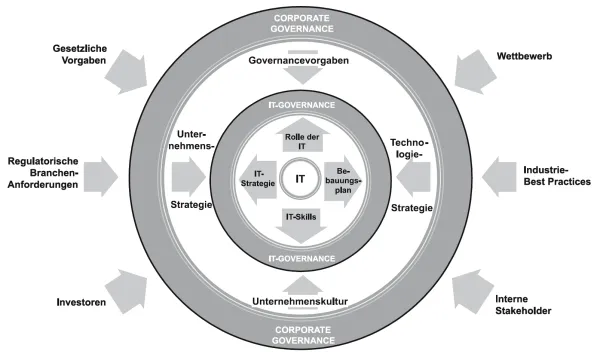 Figure 6: Factors influencing corporate governance and requirements for IT governance.9
The “IT governance” project can never be completed. The constantly changing economic environment, new regulatory requirements or changes to the company’s structure require regular review and adjustment of the IT governance guidelines.10 The relationship between IT governance, IT strategy and the processes required for it is illustrated in Figure 7:
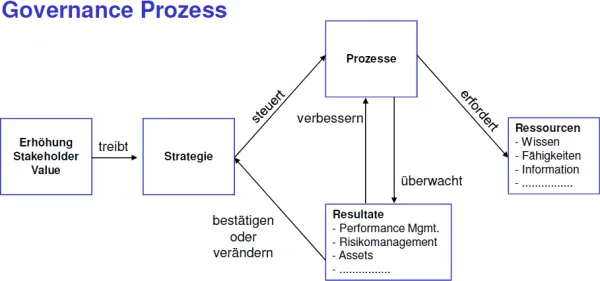 Figure 7: IT governance process.11
The IT strategy is an important steering instrument of IT governance.12 Conversely, this means that, as part of IT governance, basic rules and guidelines for the “alignment” of the IT strategy with the business goals must also be set up in small and micro enterprises.13 IT governance is not the focus of this thesis, however, and is therefore not covered in more detail here.
3.3. IT Compliance
The term “compliance” describes the measures by which a company complies with all relevant laws, provisions and regulations, but also standards and industry and association standards. Corporate compliance and IT compliance are closely interlinked in many areas. The core areas affecting IT are security and risk management, data storage and the availability of systems and services.14
Compliance exists when all requirements that are binding for the company, or accepted as binding, are demonstrably met.15
Although small and micro enterprises also have to meet a wealth of regulations, only 55 percent of these companies rate the importance of IT compliance as “high” or “very high”.16 In Capgemini’s study “IT Trends 2012”, compliance ranks only 9th of 14 in the list of “requirements for IT in 2012”.17
3.4. IT Risk and Security Management
As part of IT governance, IT security management is not purely an IT topic, but must be supported by suitable personnel and organizational measures. It is often only one part of company-wide risk management. Computer errors, service interruptions, data loss and computer crime affect companies of all sizes, but can be existentially threatening especially for small and micro enterprises with few IT systems.18 Nevertheless, only 15 percent of small companies employ an IT security officer.19
A risk assessment can be used to evaluate the probability of occurrence and the costs caused by a problem.20 The requirements for risk management come from various legal provisions and aim to secure the continued existence of the company. The literature offers a whole series of guidelines and best practice approaches. At present, the standard ISO 31000:2009 is state of the art.21 Examining risk management across all areas of a company would go beyond the scope of this thesis, however. For this reason, only the part of risk management directly related to the IT strategy is described in more detail below.
3.5. IT Controlling
The main task of IT controlling is to steer and coordinate the IT organization. Because of the change of IT from a pure cost factor to a “business partner” already described in chapter 2.2, the function of controlling in IT also shifts away from cost analysis toward presenting value contributions and performance.22 As shown in Figure 8, Horváth divides IT controlling into the dimensions “level”, “object” and “aspect”:
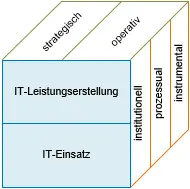 Figure 8: Dimensions of IT controlling.23
Strategic IT controlling is concerned with ensuring effectiveness and tries to answer the question “Are we doing the right things?”, while operational controlling focuses on efficiency (that is, the question “Are we doing things right?”).24 The “object” dimension refers to the perspective of IT controlling. IT use concerns the users’ perspective, IT service production that of the company.
The possibilities of IT controlling are covered in more detail in chapter 6.
Footnotes
-
Cf. (Ward & Peppard, 2005, p. 80). ↩
-
Cf. (Resch, Brenner, & Schulz, 2009, p. 242). ↩
-
Cf. (Weiand, 2012, p. 136). ↩
-
Also “Responsibility Assignment Matrix”. Cf. (Jacka & Keller, 2009, p. 257), (Schmid, IT-Governance, 2007, pp. 309 and 319). ↩
-
Cf. (Laudon, Laudon, & Schoder, 2010, p. 918), (Maicher & Schwarze, 2003, p. 44), (Bergmann & Tiemeyer, 2011, p. 464). ↩
-
Cf. (Österreichischer Arbeitskreis für Corporate Governance, 2012, p. 11). ↩
-
Cf. (Laudon, Laudon, & Schoder, 2010, p. 269), (Schmid, IT-Governance, 2007, p. 292). ↩
-
Cf. (Rüter & Schröder, 2006, pp. 4 and 45). ↩
-
Source: (Rüter & Schröder, 2006, p. 5). ↩
-
Cf. (Rüter & Schröder, 2006, p. 44). ↩
-
Source: (Schröckner, 2008, p. 17). ↩
-
Cf. (Rüter & Schröder, 2006, p. 45). ↩
-
Cf. (Schmid, IT-Governance, 2007, p. 293f). ↩
-
Cf. (Laudon, Laudon, & Schoder, 2010, p. 877). ↩
-
(Klotz, 2011, p. 586). ↩
-
Cf. (Kronschnabl, 2010, p. 19). ↩
-
Cf. (Capgemini, 2012, p. 13). ↩
-
Cf. (Laudon, Laudon, & Schoder, 2010, p. 1035). ↩
-
Cf. (Kronschnabl, 2010, p. 15). ↩
-
Cf. (Laudon, Laudon, & Schoder, 2010, p. 1048). ↩
-
Cf. (Brühwiler, 2008, p. 26), (Ketterer, 2009, p. 4). ↩
-
Cf. (Krcmar & Schwertsik, 2011, p. 339). ↩
-
Source: adapted from (Horváth, 2001). ↩
-
Based on Peter Drucker’s well-known quote “Efficiency is doing things right. Effectiveness is doing the right things.”. ↩