
Chapter 1: Introduction
Chapter 1 of my master's thesis "Outsourcing the IT Strategy Development Process in Austrian Small and Micro Enterprises"
Contents
This article series contains my master’s thesis “Outsourcing the IT Strategy Development Process in Austrian Small and Micro Enterprises”, which I wrote as part of the university program Management in Information and Business Technologies at the Alpen-Adria-Universität Klagenfurt.
- Chapter: Introduction
- Chapter: Definitions
- Chapter: Relevant Environments of Small and Micro Enterprises in Austria
- Chapter: Strategic Goals and Critical Success Factors of an IT Strategy
- Chapter: Strategic Courses of Action for Small and Micro Enterprises Regarding the Use of Information Technology
- Chapter: IT Controlling in Small and Micro Businesses
- Chapter: Summary and Outlook
1. Introduction
1.1. Problem Statement
98 percent of the Austrian business landscape consists of small companies with fewer than 50 employees.1 Because of their comparatively limited financial, personnel and time resources, these “small and micro enterprises” focus mainly on day-to-day operations.2 As a result, most small businesses’ management neglects the development of business and IT strategies or pursues it only “on the side”.3 In addition, only 25 percent of companies of this size employ IT staff.4 Hardly any of these companies can show a fully formulated IT strategy whose goals are written down and measured regularly.5
Considering that business processes today run with IT support even in micro enterprises - be it communicating with customers by email, managing supplier contacts electronically or printing invoices - the great need for support from “outside” becomes obvious. Nevertheless, entrepreneurs from small and micro businesses rarely work with external IT consultants.6 Drawing up a concrete IT strategy is perceived as too complicated and time-consuming as long as the need isn’t recognized. In times of crisis, in turn, other matters are more important and there is no longer enough budget for expensive consulting.
In these companies, IT is often not managed at all or only rudimentarily. The disadvantages go beyond day-to-day operations, such as poorly maintained IT systems, data loss or cybercrime, and also include medium- and long-term competitive disadvantages, for example through missed business opportunities.7
1.2. Objectives
Based on a literature review, this thesis tries to work out how an external consultant - also called a “service provider” below - can support small and micro enterprises, in the sense of “outsourcing”, in creating, implementing and continuously managing an IT strategy. The focus is clearly on companies in Austria without their own IT staff. The following chapters try to filter out the relevant material from the available literature, derive the quintessence of IT strategy development from the numerous sources and condense it into simple steps that even micro enterprises can implement. Since small and micro enterprises can hardly afford the time and personnel for a strategy development process lasting several months, the simplicity of the measures to be implemented comes first.
In summary, the research content can be defined as follows:
It has to be clarified what value contribution outsourcing the development, implementation and management of an IT strategy can offer small and micro enterprises from an operational, strategic and organizational point of view.
In addition, answers are worked out to the following questions related to the research question:
- Which topics and measures must an IT strategy for small and micro enterprises contain?
- Which topics and measures should an IT strategy for small and micro enterprises contain?
- What information must the service recipient provide to enable a service provider to create a value-adding IT strategy?
It is not the goal of this thesis to produce a fully worked-out strategy handbook. Mainly, it aims to bring ideas and concepts for developing IT strategies for small and micro enterprises closer to the reader.8 Developing business strategies as the basis of an IT strategy would also go beyond the scope and is therefore not covered in depth. It should be noted, however, that the business strategy is an indispensable basis for developing an IT strategy.
1.3. Approach and Structure of the Thesis
While the first chapter presents the problem statement and goals of this thesis, the second chapter deals with the individuality of small and micro enterprises. Starting with statistics and figures from the Austrian Federal Economic Chamber and Statistik Austria, it points out the importance of small and micro enterprises within the business landscape. A distinction from large and medium-sized enterprises follows.
The third chapter addresses and describes important terms concerning the corporate environment in the area of strategy development. The largest part of the third chapter is devoted to the topics IT governance, IT compliance, IT risk management and IT controlling and shows how these topics interact with the development of IT strategies. It also covers the interest groups involved in these companies, called “stakeholders” in the literature.
The fourth chapter describes the content and course of an IT strategy development process. The focus is on presenting methods that are feasible with the limited resources of small and micro enterprises. This chapter also looks more closely at the critical success factors for implementing an IT strategy and shows example key figures for measuring effectiveness.
The fifth chapter deals with exemplary courses of action for implementing the IT strategies described in chapter 4. The courses of action are presented in simplified form to make implementation possible with the limited resources of a small or micro enterprise. It shows which measures can be carried out with or by an IT service provider and which prerequisites are necessary for that.
Chapter six deals with the question of how concrete success can be measured and managed during and after the introduction of an IT strategy. Since small and micro enterprises rarely have access to extensive reporting or business intelligence systems, the simplest possible handling of the measurement and management systems is again the priority. The state of the art here is developing and using a balanced scorecard for IT. Two frameworks are presented for this in this chapter.
The seventh chapter offers a concluding summary and an outlook from the perspective of an IT services company that will put the concepts described in the previous chapters into practice.
In summary, Figure 1 shows the structure of this thesis:
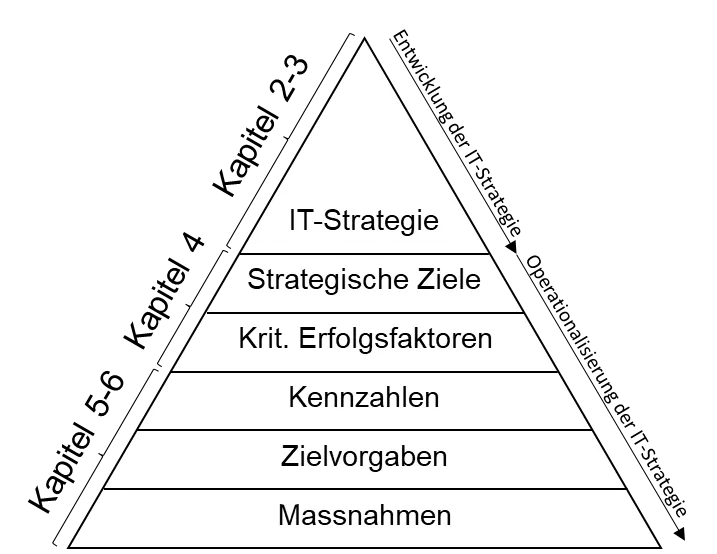 Figure 1: Structure of this thesis.9
1.4. Target Groups of This Thesis
This thesis looks at the problem described above from the perspective of a small or micro enterprise that employs no IT specialists of its own. The primary target group is therefore managers and those responsible for IT in these companies, and their investors.
In the broadest sense, service providers from IT and management consulting who want to look at their services from a different angle are also part of the target group.
Footnotes
-
Cf. (WKO, 2011, p. 1). ↩
-
Cf. (Kummert, 2005, p. 156). ↩
-
Cf. (Kraus, Harms, & Schwarz, 2007, p. 392). ↩
-
Cf. (Djahangiri, Edelhofer, & Haßl, 2013, p. 20). ↩
-
Cf. (Schmid, IT-Strategie, 2007, p. 31), (Lux & Hauser, 2007, p. 25). ↩
-
Note that external consultants in this context are understood as experts in this field. ↩
-
Cf. (Porter, 2011, p. 28). ↩
-
Provided the reader is familiar with the know-how of the topic. ↩
-
Source: adapted from (Schmid-Kleemann, 2004, p. 138). ↩